What Do You Need to Sort Out Before Fishing in Portugal?
What Do You Need to Sort Out Before Fishing in Portugal?
You have picked the stretch of coast, checked the swell forecast, and maybe even booked a place near a harbour wall or a rocky point. Then the practical question lands: what actually has to be in place before you can legally wet a line? This is where most trip planning quietly falls apart. People research rods, reels and bait for weeks, then discover at the last minute that mainland Portugal treats recreational sea fishing as a licensed activity, and that the paperwork sits between them and the water.
I spent time comparing the different routes people use to get ready for fishing in portugal, and the pattern is consistent. The anglers who enjoy their first session without stress are not the ones with the most expensive tackle. They are the ones who sorted their authorisation early, understood which rules apply to their style of fishing, and packed for the specific coast they were visiting rather than for an imaginary generic shoreline. This piece is written for that stage of the process, the preparation stage, and it assumes you already know you want to fish. The question is what has to happen before you start.
Which Licence Applies to Your Type of Sea Fishing?
Portugal’s mainland recreational sea fishing is administered under the DGRM framework, and the key distinction is between fishing from the shore and fishing from a boat. Shore angling, which includes casting from beaches, rocks, piers and harbour arms, is the most common category for visitors. Boat-based recreational fishing, whether on a charter or a private vessel, generally sits in a slightly different administrative space, and the operator or skipper often has responsibilities layered on top of your own. If you are booking a guided trip, ask the operator directly what is included, because some charters handle authorisation for everyone on board while others expect each angler to arrive ready.
Freshwater fishing is a separate world entirely. River and reservoir angling in Portugal is managed through different permits, often with regional variations and sometimes with additional requirements for specific species or protected areas. If your plan mixes a few days of coastal casting with an afternoon on a river, do not assume one document covers both. Treat them as two separate preparations. The coastal licence does not travel inland with you.
There is also a distinction between recreational and commercial activity that matters more than people expect. Selling your catch, even informally, moves you out of the recreational category. For a holiday angler this is rarely relevant, but it is worth knowing that the rules are structured around intent and use of the catch, not just the equipment in your hands.
How Do You Actually Get the Authorisation in Place?
Historically, the friction here was significant. The official route involved navigating a government portal, and for foreign visitors it often required a Portuguese tax number, the NIF, before the system would even let you proceed. That single requirement derailed plenty of trips, because obtaining a NIF typically means a trip to a finance office or a local representative, which is not how anyone wants to spend the first morning of a short holiday.
This is the gap that services like fishing license applications are built to close. Instead of working through the government portal yourself, you complete a short online form, pay by card, Apple Pay or Google Pay, and receive the authorisation without needing a NIF or direct access to the official system. The application itself takes roughly three minutes, which changes the calculus completely for anyone arriving on a Friday and wanting to fish on Saturday.
When I compared the options, the trade-off was straightforward. The direct official route costs less in fees but costs far more in time, language handling and administrative detours, especially if you do not have a Portuguese tax number. The assisted route costs a small service premium and removes almost all of the friction. For a visitor on a fixed itinerary, the second option usually wins on pure practicality. For a resident who already has a NIF and is comfortable with Portuguese-language portals, the direct route can make sense. Neither is wrong; they suit different people.
Whichever route you choose, do it before you travel, not after you arrive. Mobile data at a remote coastal campsite is unreliable, and discovering a problem with your application while standing in a car park at dusk is a miserable experience.
What Gear and Conditions Should You Prepare For?
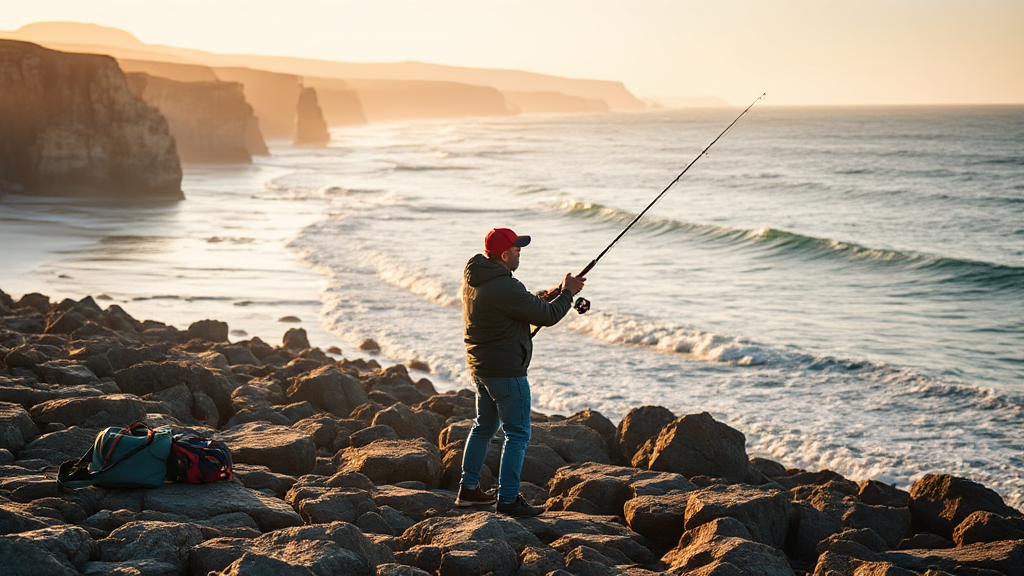
The Portuguese mainland coast is not one environment. The Algarve’s southern shoreline is warmer, often calmer, and popular for lighter setups targeting sea bream, bass and mackerel. The Atlantic-facing west coast, running up from the Alentejo through the Lisbon region and beyond, is a different proposition entirely. Swell is bigger, currents are stronger, and the rocks are genuinely slippery. The north, toward Porto and the Minho, adds cooler water and more unpredictable weather.
For shore fishing, a rod in the nine to eleven foot range covers most situations, paired with a reel that can handle both light lures and heavier bottom rigs. Bring more terminal tackle than you think you need, because local shops may be closed on Sundays or located further from your spot than expected. A headlamp, a decent pair of grippy boots and a landing net are not optional extras on rocky marks. They are safety equipment.
Bait strategy depends on your target. Squid, sardine and prawn are widely available and effective for bottom fishing. Lures work well for bass and mackerel, particularly around dawn and dusk. If you are new to the area, spending an hour watching local anglers before you commit your own rig is one of the highest-value things you can do. Their setup tells you more about the mark than any forum post.
Conditions deserve real respect here. The Atlantic is powerful, and a flat morning can turn into a dangerous afternoon. Check the swell and wind forecast daily, not once at the start of the trip. If a mark feels wrong, leave. No fish is worth the risk, and the Portuguese coast has plenty of accessible alternatives when the exposed rocks are too rough.
What Do Experienced Anglers Get Wrong First Time?
The most common mistake is treating authorisation as an afterthought. People assume they can sort it on arrival, then find the process slower or more complicated than expected. Sorting it in advance removes an entire category of stress and lets you focus on the actual fishing.
The second mistake is underestimating the coast. Anglers arrive with gear tuned for gentle conditions and find themselves on an exposed Atlantic mark with too light a rod and too little grip underfoot. Match your kit to the specific stretch you are fishing, not to a general idea of Portugal.
The third is ignoring local rules on size limits and protected species. These vary, they are enforced, and ignorance is not a defence. A few minutes reading up on what you can and cannot keep protects both the fishery and your trip.
The fourth is logistical: no backup plan for weather. The Atlantic does not care about your schedule. Having two or three alternative marks in mind, including sheltered options, means a blown-out day does not become a wasted day.
Finally, many visitors never speak to anyone local. A short conversation at a tackle shop about portugal fishing conditions will usually save you hours of trial and error and point you toward marks that actually produce at that time of year.
Frequently Asked Questions About Fishing in Portugal
Do I need a licence to fish from the shore in mainland Portugal?
Yes. Recreational sea fishing from the shore in mainland Portugal requires authorisation under the DGRM framework. This applies to visitors as well as residents, so plan to have it in place before you fish rather than assuming it is only a formality for locals.
Can I get the authorisation without a Portuguese tax number?
Through the official portal, a NIF is often required, which is difficult for short-stay visitors. Assisted application services exist specifically to bypass that requirement, letting you apply online with a card, Apple Pay or Google Pay in about three minutes without a NIF or direct government portal access.
How far in advance should I arrange everything?
Ideally before you travel. Applications through an assisted service are quick, but leaving it until you arrive introduces unnecessary risk, especially if you are heading to a remote coastal area with unreliable connectivity. Sort the authorisation first, then pack your gear.
Does the same authorisation cover boat fishing?
Not necessarily. Shore and boat-based recreational fishing can fall under different arrangements, and charter operators vary in what they handle for passengers. Confirm directly with your operator what is included and what you need to arrange yourself.
If you take one thing from this comparison, make it sequencing. Sort the authorisation first, match your gear and expectations to the specific coast you are visiting, and build in a weather backup. Do that, and the preparation stops being an obstacle and becomes the reason the trip runs smoothly. The fishing itself is the easy part once everything else is already handled.